
Quick answer
- Saint Nicholas was a 4th-century Christian bishop of Myra in Lycia, a region now in southern Turkey.
- Stories about his secret generosity helped shape winter gift-giving customs across Europe.
- The Dutch name Sinterklaas became Santa Claus in North American English.
- Modern Santa combines Saint Nicholas with Father Christmas, regional folklore, American poetry, and 19th-century illustration.
- Families can honor the tradition with generosity, storytelling, regional foods, and a Santa ritual that suits their household.
The History of Santa Claus and Saint Nicholas in One Clear Answer
The history of Santa Claus begins with Saint Nicholas, a Christian bishop who lived in the 4th century in Myra, a port city in Lycia, now near Demre in southern Turkey. He became associated with generosity, particularly gifts given to people who could not repay him. Across the centuries, stories about Nicholas joined European winter customs, the Dutch Sinterklaas tradition, and American Christmas storytelling. That layered history produced the Santa Claus recognized by families today.
Records about Nicholas are limited, and several famous episodes appear in later legends rather than in contemporary biographies. His feast day, December 6, nevertheless became a fixed date in Christian calendars and local celebrations. Children in parts of Europe receive fruit, nuts, sweets, coins, or small presents on the evening of December 5 or the morning of December 6. In the United States, the saint’s identity gradually merged with Christmas Day gift-giving. Santa is therefore not one person invented at one moment; he is a cultural figure shaped by religion, folklore, literature, art, immigration, commerce, and family practice.
The basic timeline
- Around AD 270: Nicholas is traditionally believed to have been born in Patara, Lycia.
- Around AD 300: He is associated with the bishopric of Myra.
- December 6: Saint Nicholas’s traditional feast day is observed.
- 11th to 15th centuries: Saint Nicholas customs spread through European churches and communities.
- 1087: Sailors from Bari are said to have transported Nicholas’s relics from Myra to Bari, Italy.
- 17th century: Dutch settlers carry Sinterklaas traditions to New Amsterdam, the settlement that became New York City.
- 1809: Washington Irving publishes a humorous version of Saint Nicholas in “A History of New York.”
- December 23, 1823: “A Visit from St. Nicholas” appears in the Troy Sentinel in Troy, New York.
- 1860s onward: Thomas Nast’s illustrations add familiar North Pole and workshop details.
For a concise overview of the historical figure and later traditions, see the Saint Nicholas history.
Who Was Saint Nicholas, and What Is Historically Known?
Saint Nicholas was a bishop connected with Myra, an ancient city near modern Demre in Antalya Province, Turkey. Tradition places his life during the reign of the Roman emperor Diocletian and the later reign of Constantine the Great. Later accounts describe Nicholas as a church leader who protected vulnerable people and helped them without seeking public credit. His reputation expanded after his death, although surviving evidence does not provide a complete, securely dated biography.
The best-known legend concerns a poor man with three daughters who could not afford marriage dowries. Nicholas supposedly dropped bags of gold through a window, giving the family enough money for the daughters to marry. In some retellings, the gold lands in stockings or shoes drying beside a fire. The story helps explain later customs: anonymous gifts, coins in shoes, stockings hung near a hearth, and the idea that generosity does not require applause.
Legend, evidence, and respectful storytelling
- Historically grounded: Nicholas was a bishop of Myra and became a widely honored saint.
- Traditional but uncertain: The exact dates of his birth, death, and individual charitable acts are not securely documented.
- Legendary: Stories about sailors, children, dowries, and miraculous rescues developed through later retellings.
- Culturally important: The legends emphasize generosity, protection, courage, and care for neighbors.
Nicholas’s relics are associated with Bari, Italy, after sailors moved remains from Myra in 1087. Myra remains an archaeological site near Demre, with rock-cut tombs and a Roman theater. When explaining the story to children, say “a very old tradition tells us” instead of presenting every detail as confirmed fact. Children can understand the difference between evidence and legend without losing the story’s emotional force. The central lesson is clear even when the biography is not: help someone who needs it, and do so without demanding recognition.
Make it magical with a video from Santa
Santa says your child's name, city and proudest achievement — in a real personalized video. Watch a free preview in 60 seconds.
How Saint Nicholas Traditions Spread Across Europe
Saint Nicholas customs spread through churches, monasteries, merchants, and local celebrations. In medieval Europe, December 6 could include a church service, a procession, role-playing, charitable gifts, or a meal shared with neighbors. Children might receive apples, walnuts, hazelnuts, gingerbread, or coins. In some communities, a child was chosen as a “boy bishop” for a short period, creating a playful reversal of authority around the feast day.
Each region added its own calendar, clothing, foods, companions, and rules. In the Netherlands, Sinterklaas traditionally arrives by boat and rides a white horse. Families may put shoes near a fireplace, door, or window, sometimes with a carrot or hay for the horse. In parts of Germany and Austria, Saint Nicholas appears with a companion such as Knecht Ruprecht or Krampus, depending on local custom. In Italy, Saint Nicholas traditions are especially strong in Bari, where the Festa di San Nicola includes a major celebration in May connected with the relics and another observance in December for the saint’s feast day.
Common regional variations
- Dutch Sinterklaas: Gifts or treats arrive around December 5, called Pakjesavond, or gift evening.
- German Nikolaus: Children often polish boots and leave them out on December 5 so they can be filled with treats overnight.
- Austrian customs: Saint Nicholas may appear with Krampus in a formal procession or a family visit.
- Italian Bari: The Festa di San Nicola takes place in May, with a sea procession and religious ceremonies.
- North American Santa: The main visit usually occurs on Christmas Eve, December 24, with gifts opened that night or on Christmas morning.
These differences are not errors in the tradition. They show how a shared figure adapts to language, geography, calendars, food, clothing, and local beliefs. A family might put out shoes on December 5, serve speculaas or gingerbread, and still keep stockings for Christmas Eve. Parents can explain the two customs side by side rather than treating one as the only correct version.
How Sinterklaas Became Santa Claus in America
The name Santa Claus developed from the Dutch Sinterklaas, a shortened form of Sint Nikolaas. Dutch settlers brought the name and related customs to New Amsterdam, the settlement that later became New York City. English speakers gradually reshaped the pronunciation and spelling. The character also shifted from a saint associated with December 6 to a Christmas Eve visitor who brings gifts on December 24 or Christmas morning.
Two 19th-century works had an especially strong influence. Washington Irving described a humorous Saint Nicholas in his 1809 book “A History of New York.” On December 23, 1823, the Troy Sentinel in Troy, New York, published the anonymous poem “A Visit from St. Nicholas,” commonly called “‘Twas the Night Before Christmas.” The poem presented a nighttime visitor, a sleigh, reindeer, stockings, and a cheerful gift-bringer. It helped move the American character away from a local saint’s feast and toward a household Christmas ritual.
Illustrator Thomas Nast added more visual details in magazine drawings beginning in the 1860s. His work helped establish a North Pole home, a workshop, elves, a list of children, and a larger gift-making operation. Later advertising spread a red-suited Santa internationally, but advertising did not create the entire tradition. It standardized and amplified a character already built from Saint Nicholas stories, Father Christmas, European winter customs, poetry, and illustration.
What changed in the American version?
- Calendar: December 6 shifted toward December 24 and December 25.
- Role: A local saint and charitable visitor became a gift-bringer for many families.
- Travel: A walking procession or horse became a flying sleigh pulled by reindeer.
- Setting: European villages, churches, and town squares became a North Pole home and workshop.
- Family ritual: Shoes and small treats expanded into stockings, letters, Santa visits, Christmas Eve stories, and Christmas morning gifts.
Family Activities Based on the History of Santa Claus and Saint Nicholas
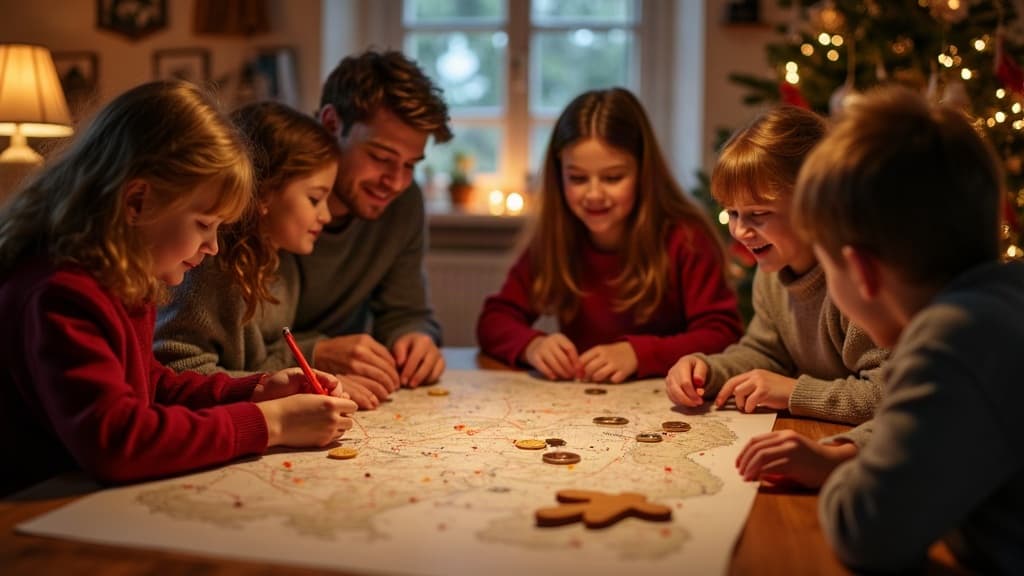
A history activity works best when children have something specific to handle, place, draw, or taste. Begin with a map. Show Myra near Demre in Turkey, Bari in Italy, the Netherlands, and New York City. Explain that stories traveled with people and changed as families retold them. Children can place 270, 1087, 1809, 1823, and the 1860s on a strip of paper. They can draw an arrow from Myra to Bari, then another from the Netherlands to New Amsterdam. The map turns a long cultural journey into a sequence they can see.
Next, connect the history to generosity. Ask each child to choose one private act of kindness: leave a note for a sibling, donate a book, carry groceries for a neighbor, help prepare soup, or set the table without being asked. Explain that old Saint Nicholas stories focus on giving without applause. If your family enjoys personalized traditions, pair the lesson with a letter from Santa that praises one specific action rather than listing only presents. A note that says “You noticed your brother was tired and brought him water” feels more meaningful than a general claim that a child has been “good.”
Printable-worthy family checklist
- □ Find Myra, Bari, the Netherlands, and New York City on a map.
- □ Mark December 5, December 6, December 23, December 24, and December 25 on a calendar.
- □ Read a child-friendly version of the three-daughters legend.
- □ Compare one local Saint Nicholas custom with your family’s Santa custom.
- □ Prepare speculaas, kruidnoten, gingerbread, apples, nuts, or chocolate coins, checking allergies first.
- □ Complete one quiet act of generosity.
- □ Look at an illustration of Saint Nicholas or Santa and list three details the artist added.
- □ Let each child ask one historical question and look for a reliable answer.
For younger children, keep the story to five minutes and use pictures: a map, a shoe, a gold coin, and a red sleigh are enough to begin. Older children can compare a map, a poem, an illustration, and a modern Santa book. Ask them which details belong to Saint Nicholas, which belong to later folklore, and which belong to their household. A short personalized video from Santa can reinforce the family lesson by mentioning a child’s kindness, a chosen tradition, or the December 6 feast day. Keep the focus on the story and the relationship, not on producing a perfect holiday performance.
Santa Traditions: Choices, Tips, and Pitfalls to Avoid
There is no required way to celebrate Santa. A family can observe Saint Nicholas Day, Christmas Eve, Christmas morning, or more than one date. The practical choice depends on children’s ages, cultural background, religious practice, work schedules, and energy during December. Be clear about which parts are historical, which are legends, and which are your household’s playful rules. That clarity lets children enjoy make-believe without having to memorize a single official version of Santa.
Choose a tradition that fits your household
- Saint Nicholas Day on December 6 — Pros: connects directly to the saint’s feast day and encourages small gifts; Cons: adds another date to a busy month.
- Christmas Eve on December 24 — Pros: fits the familiar American Santa story and creates a focused evening ritual; Cons: anticipation can make bedtime difficult.
- Christmas morning on December 25 — Pros: keeps gifts within a routine many families already follow; Cons: the historical connection to Saint Nicholas may be less visible.
- A blended tradition — Pros: allows shoes and fruit on December 6, then stockings on December 24; Cons: requires a simple explanation so children understand why the dates differ.
Pitfalls to avoid
- Do not claim every legend is proven history.
- Do not present one country’s custom as the universal rule.
- Avoid using fear, public embarrassment, or threats to control behavior.
- Do not make generosity depend only on receiving a gift.
- Check family allergies before serving nuts, chocolate, or spiced cookies.
- Respect children who ask difficult questions; answer honestly and warmly.
- Avoid overwhelming children with too many dates, characters, and rules at once.
- Do not assume every child wants a costumed Santa visit; offer a wave, letter, story, or quiet alternative.
If a child wants to chat with Santa, set expectations first: Santa can discuss kindness, stories, and holiday hopes, but adults still handle safety, health, money, and family decisions. If a child asks whether Santa is real, answer according to your family’s values without shaming the question. You might say that Saint Nicholas was a historical bishop, that Santa is a character shaped by many traditions, and that your family enjoys keeping part of the story as make-believe. A calm explanation protects trust while leaving room for play.
Free download
Printable Letter From Santa + Nice List Certificate
Two beautiful keepsakes from the North Pole — a personalized-style letter from Santa and an official Nice List certificate. Enter your email and Santa will unlock both PDFs for you, free.
A paper letter can't say your child's name out loud
Santa can. Watch a 30-second example — he greets your child by name, city and their proudest moment of the year.
Get a video from Santa