

Quick answer
- Set a gift budget, bring one wrapped present per player, and draw numbers for turn order.
- On each turn, a player may open a wrapped gift or steal an opened gift from another player.
- Limit each gift to two or three steals, and end the game when the final player completes their turn.
- Use clear rules, age-appropriate gifts, and a written checklist to prevent confusion or hurt feelings.
White Elephant Rules at a Glance
The standard white elephant rules are straightforward: each guest brings one wrapped gift within the agreed budget, players draw numbers, and the lowest number opens a gift first. On every later turn, a player either opens a wrapped gift or steals an opened gift. The person who loses a gift immediately takes another turn. Set a steal limit before play, then give player one one final choice at the end if that rule is part of your plan.
Before guests arrive, announce the spending limit, gift theme, number of allowed steals, and whether gag gifts are welcome. A $20 limit, one gift per person, and a two-steal limit suits many adult groups. For children, replace “stealing” with “swapping” if that language feels more comfortable. The aim is playful suspense, not a contest to see who brought the most expensive present.
The basic turn sequence
- Place every wrapped gift in one central pile. Do not label gifts with the giver’s name.
- Have each player draw a number. Keep the numbers visible so everyone knows the order.
- Player one chooses and opens a wrapped gift.
- Each following player opens a wrapped gift or takes an already opened gift.
- When a gift is stolen, its new owner takes an immediate replacement turn.
- Stop a gift from circulating once it reaches the agreed steal limit.
- After the last player finishes, let player one swap once, if that rule was announced at the start.
How to Set Up a White Elephant Exchange
Good setup prevents most arguments. Send the rules with the invitation, not five minutes before the game begins. State the guest count, gift budget, theme, wrapping requirement, and whether homemade, used, practical, or humorous gifts are allowed. A $15 to $25 range is common for casual gatherings, but the right limit depends on the group. Choose one number and explain whether tax and shipping count toward it.
Plan a clear playing area with a chair or floor spot for each guest. Put opened gifts where everyone can see them, rather than behind the host’s chair or beneath the tree. Keep a marker and simple tracking sheet nearby. The host can write a number beside a gift each time it is stolen. This matters when ten or more people are playing and the same popular item changes hands several times.
Host preparation checklist
- Confirm the date, time, guest list, gift budget, and theme.
- Prepare numbered slips from 1 through the total number of players.
- Provide tape, scissors, markers, and a visible gift pile.
- Write the steal limit and final-player rule on a card.
- Choose a timekeeper if the group has more than 15 players.
- Set aside a quiet activity for children who finish early.
- Keep food and drinks away from the gift area to prevent spills.
For a family party, add a bit of Santa magic with a letter from Santa before the exchange begins. For a long December gathering, a Christmas countdown can help younger children understand when the game starts. Keep the game itself separate from any surprise reveal so children know what to expect and no one mistakes a game gift for a personal present.
Make it magical with a video from Santa
Santa says your child's name, city and proudest achievement — in a real personalized video. Watch a free preview in 60 seconds.
White Elephant Rules for Stealing and Swapping
Stealing is what separates a white elephant exchange from an ordinary grab bag. A player may take an opened gift, but may not grab a wrapped gift that someone else has selected and not yet opened. The player who loses a gift immediately chooses again. They may open a new gift or steal a different eligible gift, but they cannot instantly take back the same gift unless your house rules specifically allow it.
Most groups use a limit of two or three steals per gift. Count a completed theft, not every time a player touches or considers a gift. Once the limit is reached, mark that present as frozen; its owner keeps it for the rest of the game. You can also limit how many times one person may be stolen from during a single turn. That extra guardrail prevents a long chain of repeated exchanges between two players.
Choose one rule set before play
- Two-steal limit: Fast and easy. Best for groups that want a game lasting about 20 to 30 minutes.
- Three-steal limit: Creates more suspense. Best for 8 to 15 adults who enjoy playful bargaining.
- No immediate take-back: Prevents two players from passing one gift back and forth.
- Immediate take-back allowed: More chaotic and strategic, but it can frustrate younger players.
- Final player-one swap: Gives the first player a fair closing choice because they had no open gift to steal at the start.
Say the rule aloud before the first number is called. If a question comes up, pause the game and decide consistently. Quietly changing the rule halfway through is the fastest way to make a relaxed exchange feel unfair. If the group cannot agree on a disputed play, return to the written rule; if no written rule covers it, make one decision and use it for every later turn.

White Elephant Gift Ideas and Themes
The best gifts are easy to recognize, useful enough to want, and amusing enough to discuss. A theme helps guests shop without requiring identical presents. For a practical exchange, suggest insulated mugs, cozy blankets, puzzle books, kitchen tools, or locally made treats. For a funny exchange, allow unusual household items, playful decorations, novelty socks, or a wrapped “mystery” box with a useful item inside. A gift that gets a laugh and then gets used is usually stronger than a large object no one wants to carry home.
Avoid gifts that create pressure or embarrassment. Alcohol, scented products, food containing common allergens, and adult humor may not suit every group. A host should also say whether gift cards, secondhand items, handmade goods, and re-gifting are acceptable. For a mixed-age event, separate children and adults or use two gift piles. A six-year-old should not have to compete for an item intended for a 35-year-old, and a child should never be expected to choose an unsafe or age-restricted gift.
Theme ideas with clear boundaries
- Cozy night: Blankets, cocoa, slippers, tea, puzzles, or reading accessories.
- Kitchen helper: Serving tools, baking supplies, spice blends, or cookbooks.
- Local favorite: A product made in your town, state, or region.
- Nostalgia: A game, candy, ornament, or book connected to childhood.
- Under $10: Small, funny, and accessible gifts for a large group.
- Homemade: Baked goods, crafts, preserves, or handwritten recipe collections.
Historically, the phrase “white elephant” is connected with stories about rare white elephants in Southeast Asia and the costly burden of caring for them. The popular American party game developed later as a humorous idea about an unusual or impractical present. The history of the white elephant tradition provides useful background, while modern exchanges can be adapted for any culture or family. The name does not require anyone to bring a useless gift; a good exchange can include practical presents, edible treats, or small experiences.
White Elephant Variations for Families and Parties
The classic format is not the only option. A “left-right” exchange passes gifts according to a story, while a dice exchange assigns actions such as unwrap, swap, or pass. These versions can be easier for younger children because everyone receives a wrapped gift before the main surprises begin. They also work well when guests do not enjoy direct stealing. Use large cards or a poster for dice actions so children do not have to remember several instructions at once.
For a large office or neighborhood party, divide guests into groups of 10 to 15. Games with 25 people often become slow unless you use a strict timer and a clearly marked gift area. For a small family group, add a second round or let each person bring a clue about their gift. If the party includes children under about seven, an adult can read the rules, track steals, and help with opening packages. Do not rush a child who needs help with tape or cannot comfortably carry a larger gift.
Compare common formats
- Classic steal exchange — Pros: suspenseful and social. Cons: can feel competitive for sensitive players.
- No-steal grab bag — Pros: quick and low-stress. Cons: less strategy and fewer laughs.
- Dice exchange — Pros: active and easy for children. Cons: rules can become confusing without a large visual guide.
- Theme-only exchange — Pros: shopping is simple and gifts feel connected. Cons: guests may interpret the theme differently.
- Charity exchange — Pros: supports a cause and reduces unwanted items. Cons: requires agreement about donation receipts and gift quality.
You can also replace physical gifts with experiences, family coupons, or notes promising a shared activity. Examples include a homemade dinner, an afternoon of sledding, a board-game night, or help with a household project. Explain the format clearly so guests know whether they are bringing an object, a service, or a donation. Flexibility is useful, but surprise rule changes are not. If the exchange includes promises rather than objects, set a realistic expiration date and make sure the recipient can actually use the offer.
Printable White Elephant Checklist and Game Script
Print this checklist and place it beside the host’s chair. A visible script keeps the game moving and lets the host answer questions without repeating every detail. Write the actual steal limit in the blank before guests arrive. If someone arrives late, give them a number at the end of the existing order rather than reshuffling every player. Tell the late guest exactly when their turn will occur and whether the final player-one swap still applies.
Before the party
- ☐ Choose the gift budget: $__________
- ☐ Choose the theme: ____________________
- ☐ Confirm one wrapped gift per player.
- ☐ Set the gift steal limit: __________
- ☐ Decide whether player one gets a final swap.
- ☐ Prepare number slips and a steal-tracking sheet.
- ☐ Mark food allergens and age restrictions.
- ☐ Set up chairs, lighting, trash bags, and a clear gift area.
Host script
- “Everyone has one wrapped gift and one number. We will follow the numbers from low to high.”
- “On your turn, open a wrapped gift or steal an eligible opened gift.”
- “If your gift is stolen, you take a replacement turn immediately.”
- “A gift may be stolen ______ times. After that, it is frozen.”
- “No immediate take-backs are allowed.”
- “At the end, player one may swap once: yes or no.”
Cross off each player after their turn and record frozen gifts. This small administrative step prevents skipped turns, forgotten limits, and accidental take-backs. Keep the tone warm. The host should enforce the rules without announcing that one guest made a poor gift choice. If a player needs extra time, offer two clear options rather than letting the whole group debate: open the next wrapped gift or choose one eligible present.
Common Pitfalls to Avoid
The most common problem is an unclear rule about the final turn. Player one has an advantage if they may swap after seeing every gift, but that closing option also balances the disadvantage of going first. Either include it for everyone’s understanding or leave it out. Do not decide based on who currently holds the most popular present. Write “player one final swap: yes” or “no” on the host’s card before the first turn begins.
Another problem is an unrealistic budget. If one guest brings a costly electronic item and another brings a novelty trinket, the exchange can feel unequal even when both followed the written rule. A narrow range and a theme reduce this gap. Hosts should also discourage gifts that are dirty, damaged, dangerous, sexually explicit, or likely to expose a guest’s private information. A used item can be perfectly acceptable when the group has agreed to a secondhand theme; it should not be a surprise exception.
Quick fixes for awkward moments
- A guest dislikes their gift: Let them keep it private; do not require a public reaction.
- Two guests argue over a rule: Pause, read the written rule, and apply it to everyone.
- A gift is clearly unsafe for a child: Remove it and offer a neutral replacement.
- The game runs long: Freeze gifts after two steals and use a 30-second decision timer.
- A late guest arrives: Add them at the end or give them a host-provided gift.
- A gift breaks during play: Treat it as an unfortunate accident, not a reason to shame the owner.
Finally, participation should be optional. Offer a quiet alternative for a child or adult who does not want to steal. They might choose a wrapped gift without trading, help record the turns, or join a cookie-decorating activity. A successful holiday exchange leaves people laughing together, not defending a present or regretting an invitation. Clear limits, accessible gifts, and a host who can make quick decisions do more for the mood than elaborate rules.
Free download
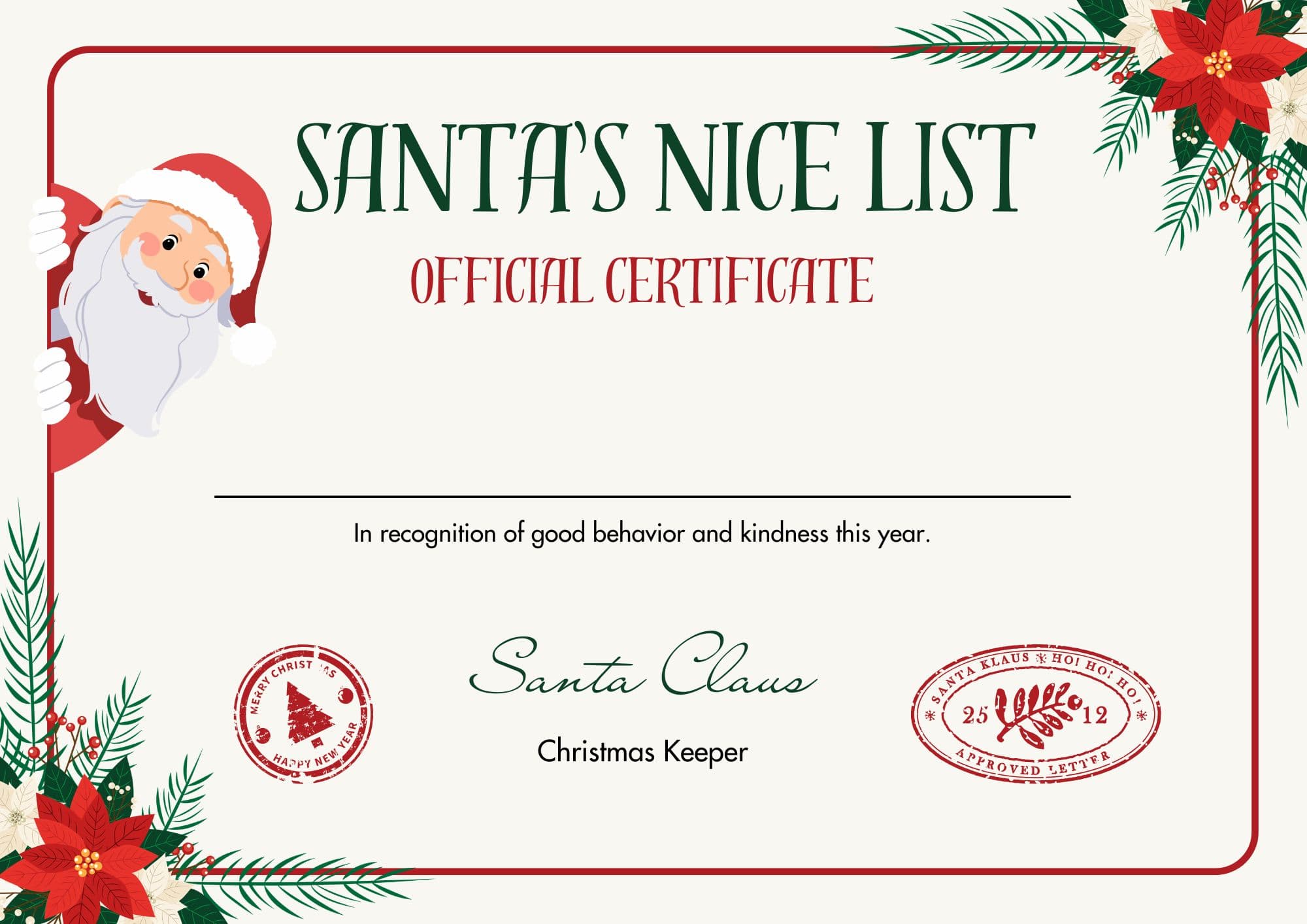
Printable Letter From Santa + Nice List Certificate
Two beautiful keepsakes from the North Pole — a personalized-style letter from Santa and an official Nice List certificate. Enter your email and Santa will unlock both PDFs for you, free.

A paper letter can't say your child's name out loud
Santa can. Watch a 30-second example — he greets your child by name, city and their proudest moment of the year.
Get a video from Santa